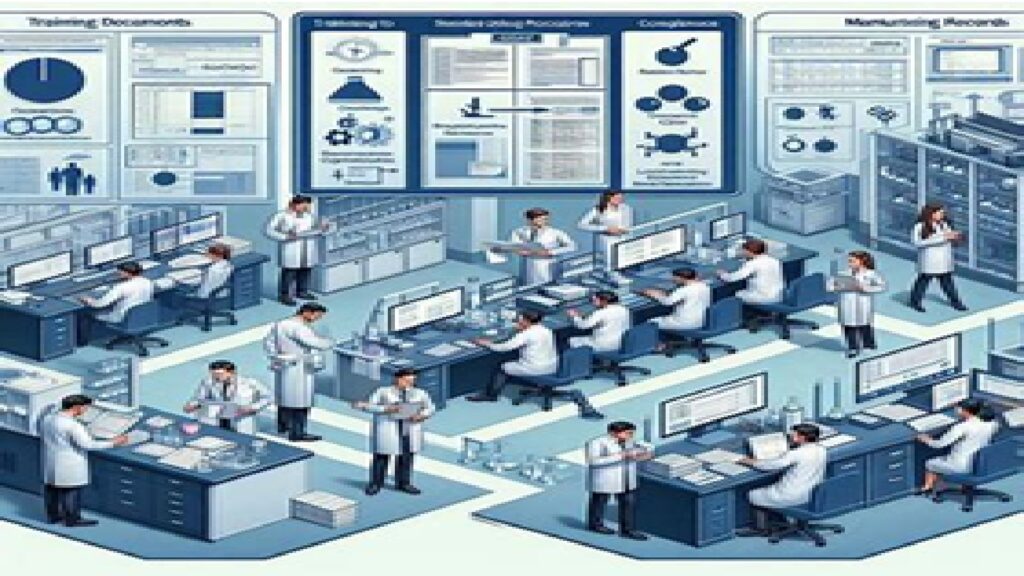

Ensuring Scientific Integrity | Regulatory Compliance | Product Quality Excellence
🎯 1. Purpose
To establish a robust, scientifically driven, and regulatory-compliant framework for the handling, investigation, and resolution of Out of Specification (OOS) results.
This SOP is designed to:
- 🔍 Ensure accurate root cause identification
- 🛡️ Protect patient safety and product quality
- 📊 Maintain data integrity (ALCOA+)
- 🔁 Drive continuous improvement through CAPA
🌍 2. Scope
Applicable to:
- 🧪 Quality Control Laboratories (Chemical, Microbiological, Instrumental)
- 📦 Raw Materials, In-Process, Finished Products
- ⏳ Stability Studies
- 🤝 Contract Testing Laboratories (if applicable)
📘 3. Key Definitions
🔴 Out of Specification (OOS):
A test result that falls outside predefined acceptance criteria
🟡 Out of Trend (OOT):
Unexpected result within specification but deviating from historical trends
🟢 True OOS:
Confirmed product-related failure
🔵 False OOS:
Result due to laboratory or analytical error
👥 4. Roles & Responsibilities
🧑🔬 Analyst
- Immediately report OOS 🚨
- Halt testing activity
- Preserve samples & raw data
- Assist in investigation
🧑💼 QC Supervisor/Manager
- Initiate Phase I investigation
- Review analytical data
- Ensure completeness of documentation
🛡️ Quality Assurance (QA)
- Provide independent oversight
- Ensure regulatory compliance
- Approve final reports
🏆 Head – Quality
- Final batch disposition decision
- CAPA approval authority
⚙️ 5. Procedure – Stepwise Scientific Approach
🚨 5.1 Immediate Actions (Zero Delay Response)
Upon detecting OOS:
- ⛔ Stop analysis immediately
- 🏷️ Label materials: “UNDER INVESTIGATION”
- 📢 Inform Supervisor & QA instantly
- 💾 Secure raw data (no deletion/modification)
🔍 5.2 Phase I: Laboratory Investigation
(Focus: Analytical / Lab Error Detection)
✅ Checklist Review
- Instrument calibration & system suitability
- Standard/sample preparation accuracy
- Reagents & glassware integrity
- Analyst performance & training
- Calculation verification
🔎 Deep Dive Analysis
- Chromatograms / spectra evaluation
- Integration parameters review
- Environmental conditions check
🎯 Outcome
- ✔️ Assignable cause found → Invalidate result (with justification)
- ❌ No cause → Proceed to Phase II
🧪 5.3 Hypothesis Testing (Scientific Justification Required)
Allowed ONLY when justified:
- Re-injection of same solution
- Fresh preparation of sample/standard
- Limited retesting
⚠️ Golden Rule:
🚫 Never “Test Into Compliance”
🏭 5.4 Phase II: Full-Scale Investigation
(Focus: Manufacturing & Material Root Cause)
🔬 Investigation Dimensions
1. Manufacturing Process
- Batch Manufacturing Record (BMR) review
- Process deviations
- Critical process parameters
2. Raw Materials
- Vendor quality & COA verification
- Storage & handling conditions
3. Equipment
- Cleaning & maintenance logs
- Calibration status
4. Analytical Method
- Validation status
- Method robustness
5. Historical Data
- Trend analysis
- Stability data comparison
🧠 5.5 Root Cause Analysis (RCA)
Apply structured tools:
- 🐟 Fishbone (Ishikawa Diagram)
- ❓ 5 Why Analysis
- ⚠️ FMEA (Failure Mode & Effects Analysis)
📌 Possible Root Causes
- Method
- Material
- Machine
- Man (Human error)
- Environment
📊 5.6 Impact Assessment
Evaluate potential risk:
- Other batches 🔁
- Released products 🏬
- Stability studies ⏳
- Regulatory implications 📜
✅ 5.7 Final Decision Matrix
| Scenario | Decision |
|---|---|
| True OOS | ❌ Batch Rejection / Reprocessing |
| Lab Error | ✔️ Result Invalidated (with evidence) |
| Inconclusive | ⚠️ Conservative decision (Reject/Recall) |
🔁 5.8 CAPA (Corrective & Preventive Actions)
🔧 Corrective Actions
- Immediate issue resolution
🛡️ Preventive Actions
- Long-term system improvements
💡 Examples:
- Analyst retraining
- Method modification
- Equipment servicing
- Process optimization
📝 5.9 Documentation Excellence
Every OOS must include:
- Unique OOS ID
- Complete test details
- Raw data & observations
- Investigation steps
- Root cause & CAPA
- Final conclusion
📌 Ensure:
- ALCOA+ compliance
- Full traceability
- Audit readiness
⏱️ 6. Timelines (Strict Compliance)
| Activity | Timeline |
|---|---|
| Phase I Investigation | 3–5 Days |
| Phase II Investigation | 15–30 Days |
| CAPA Implementation | Risk-Based |
🌐 7. Regulatory Alignment
Aligned with global standards:
- ICH Q7 & Q10
- US FDA OOS Guidance
- EU GMP
- WHO Guidelines
💡 8. Core Quality Principles
✨ Science-driven decisions
✨ No assumptions or bias
✨ No testing into compliance
✨ Transparency in data
✨ Patient safety above all
🔄 9. Process Flow (Visual Summary)
OOS Detected 🚨 → Phase I 🔍 → Hypothesis 🧪 → Phase II 🏭 → RCA 🧠 → CAPA 🔁 → Final Decision ✅
❓ FAQs: Out of Specification (OOS) Investigations
🔬 1. What is an OOS result and why is it critical in pharmaceuticals?
An Out of Specification (OOS) result is any analytical outcome that falls outside predefined acceptance criteria established in specifications, pharmacopoeias, or regulatory filings.
🔍 Criticality:
- Indicates potential product quality failure
- May impact patient safety
- Triggers regulatory scrutiny
- Can lead to batch rejection, recall, or warning letters
⚖️ 2. What is the difference between OOS, OOT, and Deviation?
| Term | Meaning | Impact |
|---|---|---|
| OOS | Result outside specification | Critical, must investigate |
| OOT (Out of Trend) | Within spec but abnormal trend | Requires trend analysis |
| Deviation | Departure from procedure/process | May or may not lead to OOS |
👉 Key Insight:
All OOS are deviations, but not all deviations are OOS.
🧪 3. What are the immediate steps after observing an OOS result?
- 🚨 Stop analysis immediately
- 📢 Inform Supervisor & QA
- 🏷️ Label samples “Under Investigation”
- 💾 Preserve all raw data (no changes)
- 📝 Record observations
⚠️ Important: Never ignore or delay reporting.
🔍 4. What is Phase I (Laboratory Investigation)?
Phase I focuses on identifying analytical or laboratory errors.
Key checks include:
- Instrument calibration
- System suitability
- Sample/standard preparation
- Analyst performance
- Calculation accuracy
🎯 Goal: Determine if OOS is due to assignable lab error
🧠 5. What qualifies as an “assignable cause”?
An assignable cause is a scientifically justified, documented reason explaining the OOS result.
Examples:
- Incorrect dilution
- Instrument malfunction
- Calculation error
- Contaminated reagent
✔️ Must be proven with evidence, not assumptions.
🧪 6. When can an OOS result be invalidated?
An OOS result can only be invalidated if:
- A clear assignable cause is identified
- The cause is documented and scientifically justified
- QA approves the decision
🚫 Without evidence, invalidation is not allowed
🔁 7. What is “testing into compliance” and why is it prohibited?
Testing into compliance refers to repeated testing until a passing result is obtained.
❌ This is prohibited because:
- Violates data integrity principles
- Masks true product quality issues
- Is a major regulatory violation (FDA concern)
🧪 8. What is the role of retesting in OOS?
Retesting is allowed only when:
- Scientifically justified
- Pre-approved by QA
- Limited in number
📌 Retesting should confirm a hypothesis, not override failure.
🏭 9. What is Phase II Investigation?
Phase II evaluates manufacturing and material-related causes when no lab error is found.
It includes:
- Batch record review
- Process deviations
- Raw material quality
- Equipment logs
- Environmental conditions
🧠 10. What tools are used for Root Cause Analysis (RCA)?
Common RCA tools:
- 🐟 Fishbone Diagram
- ❓ 5 Why Analysis
- ⚠️ FMEA
🎯 Aim: Identify true root cause, not symptoms
📊 11. What is Impact Assessment in OOS?
Impact assessment determines the extent of risk:
- Other batches affected
- Released products in market
- Stability samples
- Regulatory implications
📌 Helps decide recall or further action
⚖️ 12. What decisions can be taken after OOS investigation?
- ✔️ Batch Acceptance (if lab error proven)
- ❌ Batch Rejection (true OOS confirmed)
- 🔁 Reprocessing/Rework (if justified)
- 🚨 Recall (if product already distributed)
🔁 13. What is CAPA in OOS?
CAPA (Corrective and Preventive Action) ensures:
- Immediate correction of issue
- Prevention of recurrence
Examples:
- Analyst retraining
- SOP revision
- Equipment maintenance
📝 14. What documentation is required in OOS investigation?
- OOS report
- Raw data (chromatograms, worksheets)
- Investigation details
- RCA documentation
- CAPA plan
- Final conclusion
📌 Must comply with ALCOA+ principles
⏱️ 15. What are the regulatory timelines for OOS investigations?
- Phase I: 3–5 working days
- Phase II: 15–30 days
- CAPA: Based on risk
⚠️ Delays must be justified and documented.
🌐 16. What do regulatory agencies expect in OOS investigations?
Authorities like FDA, EMA, WHO expect:
- Scientific justification
- No data manipulation
- Complete documentation
- Robust RCA
- Effective CAPA
🚨 17. What are common mistakes in OOS investigations?
❌ Ignoring initial OOS result
❌ Excessive retesting
❌ Weak root cause analysis
❌ Poor documentation
❌ Bias towards passing results
📉 18. What is the role of trending in OOS management?
Trending helps identify:
- Recurring issues
- Process variability
- Early warning signals
📊 Prevents future OOS through proactive control.
🧪 19. Can averaging of results be used to pass a batch?
🚫 No, unless specifically allowed by method or pharmacopoeia.
Reason:
- Masks variability
- Not scientifically justified
- Regulatory non-compliance
🛡️ 20. How does OOS relate to Data Integrity (ALCOA+)?
OOS handling must ensure:
- Attributable (who performed test)
- Legible
- Contemporaneous
- Original
- Accurate
➕ Complete, Consistent, Enduring, Available
🔄 21. What is the difference between retest and reanalysis?
| Term | Meaning |
|---|---|
| Retest | Testing a new aliquot/sample |
| Reanalysis | Re-injection of same prepared solution |
🧑🔬 22. Who has final authority in OOS decisions?
- QA: Investigation approval
- Head Quality: Final batch disposition
📌 Ensures independence from QC bias
⚠️ 23. What happens if OOS is found in stability studies?
- Evaluate degradation trend
- Assess shelf life impact
- May lead to product recall or expiry revision
🔍 24. How to handle OOS in microbiological testing?
- Check contamination sources
- Review aseptic techniques
- Evaluate media and incubation conditions
📌 Micro OOS often needs more stringent controls
🧠 25. What is the most important principle in OOS investigation?
✨ Scientific Integrity
Every decision must be:
- Evidence-based
- Documented
- Justified
- Unbiased
For more articles, Kindly Click here
For pharmaceutical jobs, follow us on LinkedIn
For Editable SOPs in Word format contact us on info@pharmaceuticalcarrier.com
For more information kindly follow us on www.pharmaguidelines.co.uk