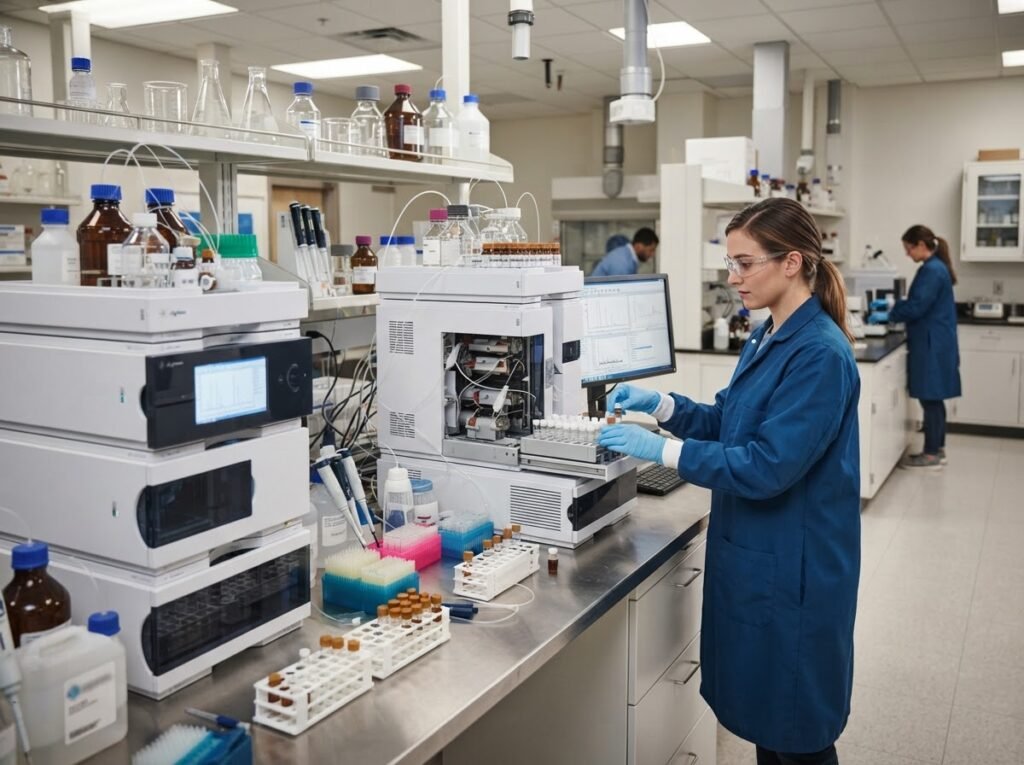
Peak tailing reduces chromatographic resolution and can compromise integration, impurity quantitation and system suitability. A tailing peak is not automatically evidence of column failure: sample chemistry, mobile phase, injection conditions and extra-column effects all matter.
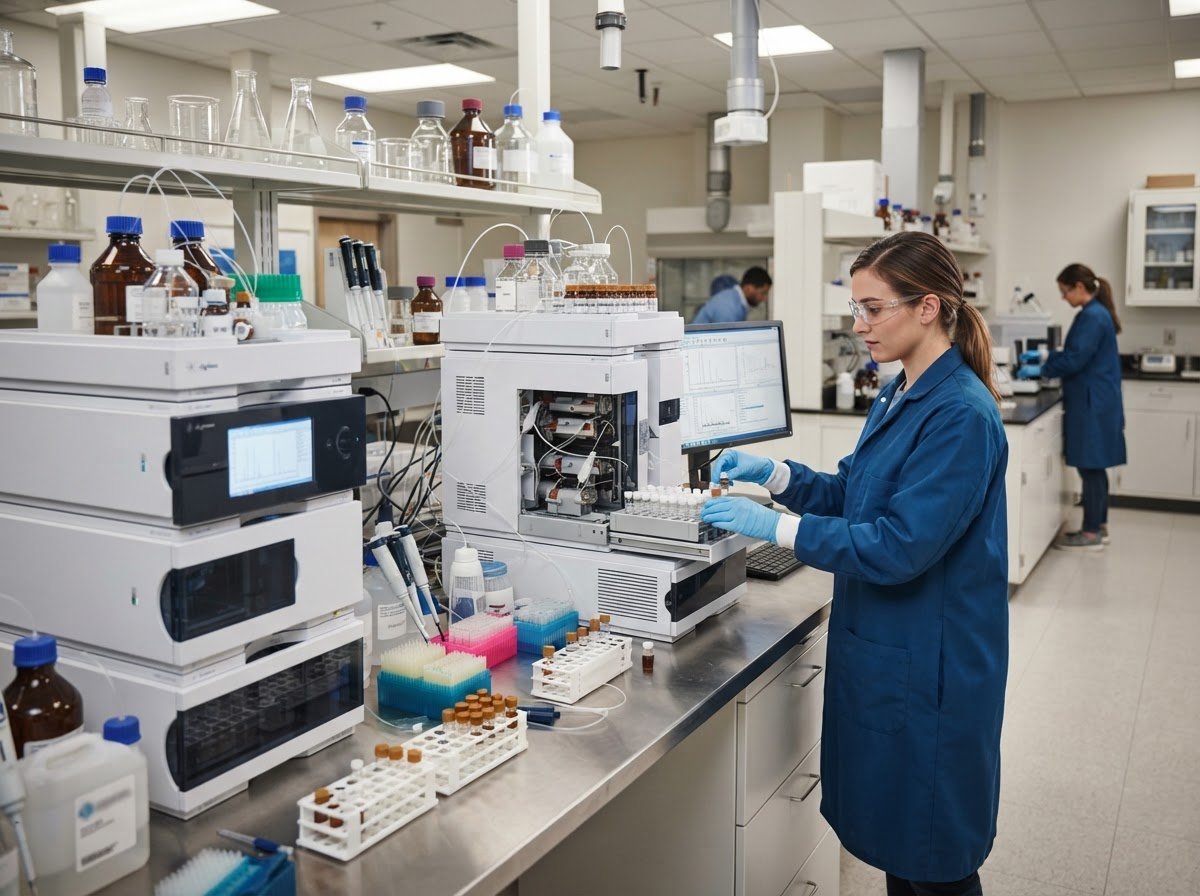
What is peak tailing?
A chromatographic peak tails when the trailing edge is more extended than the leading edge. USP tailing factor and asymmetry factor are different measures and must not be interchanged. For the commonly used USP approach, tailing factor T = W0.05/(2f), where W0.05 is the peak width at 5% of peak height and f is the distance from the peak front to the apex at that height. A symmetrical peak has a value close to 1. The actual system-suitability criterion must come from the validated method or applicable monograph.
Chemical causes: pH and secondary interactions
Basic analytes may interact with residual silanol sites on silica-based reversed-phase columns. Mobile-phase pH affects both analyte ionisation and stationary-phase interactions. Check buffer identity, pH measurement method, ionic strength and column pH limits. Never change pH outside the approved method without a documented impact assessment.
Physical causes: column and plumbing
A partially blocked inlet frit, damaged column bed, void, dead volume or poorly seated fitting can distort peaks. Compare pressure history, efficiency and retention time with the column’s established performance. Extra-column tubing volume is especially important for narrow-bore columns and small peak volumes.
Injection solvent and sample loading
A sample dissolved in a stronger solvent than the initial mobile phase may show fronting, splitting or distorted peak shape; excessive injected mass can cause overload. Compare diluent strength, injection volume and sample concentration against the validated conditions. Check for sample precipitation or adsorption.
Systematic troubleshooting sequence
First preserve the original chromatogram, sequence and audit trail. Verify integration settings and system suitability without changing parameters. Check blank, standard and sample patterns: a problem affecting all injections suggests system conditions; a problem limited to samples suggests matrix or preparation effects. Review mobile-phase preparation and age, pH, flow, temperature and pressure. Inspect connections and guard column, then assess column performance using an approved test. Change one factor at a time during a documented investigation; any method adjustment requires appropriate change control.
Worked example
Suppose a standard previously showed tailing factor 1.2 but now shows 2.1 against a hypothetical method limit of 2.0. Review the original data, fresh buffer preparation, column history and instrument pressure before reinjection. If a fresh correctly prepared mobile phase restores suitability, document evidence of the preparation error and assess affected injections. These numbers are illustrative, not universal acceptance criteria.
GMP records and review
Retain the original sequence, raw data, processing method and integration changes, preparation records, column identifier and usage log, system-suitability calculations, instrument maintenance, deviations and reviewer decision. Do not manipulate baseline or integration settings simply to obtain a passing tailing factor.
Further reading and primary sources
Educational guidance only. Follow current pharmacopoeial requirements, validated methods and site-approved GMP procedures.