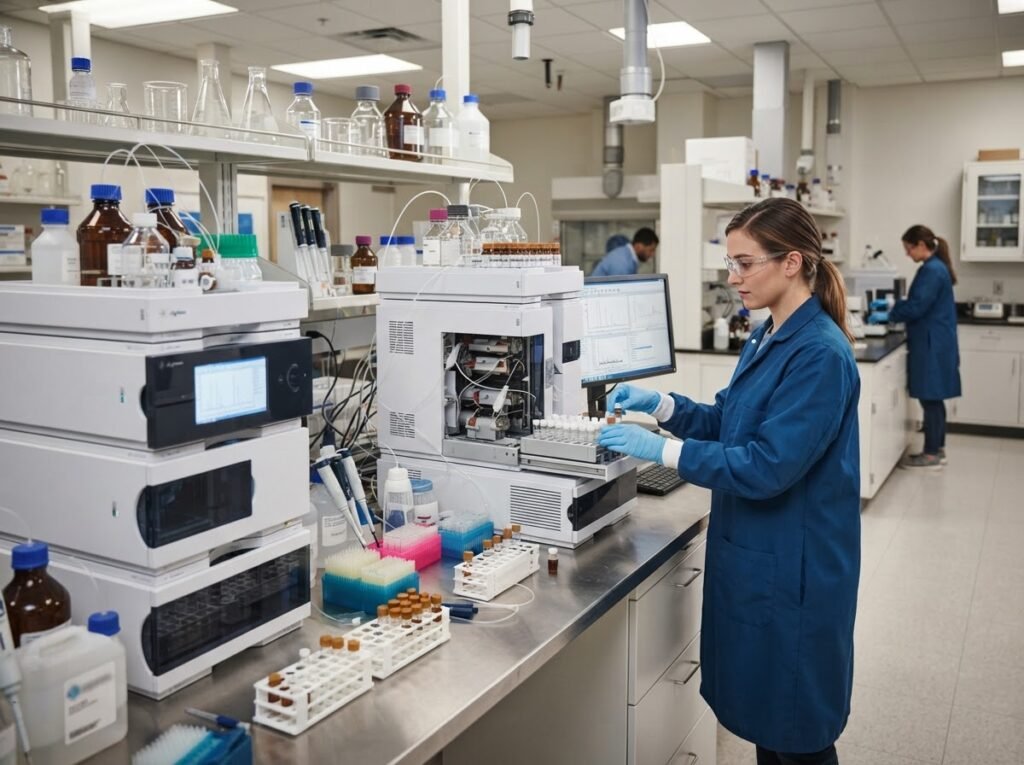
A pharmaceutical dissolution procedure should be capable of measuring relevant product performance differences, not merely generating reproducible numbers. Discriminatory ability, precision, robustness and the intended role of the test must be assessed together.
Define the intended use
A routine release dissolution test, a development comparison and a biorelevant research method may have different goals. Define dosage form, release mechanism, dissolution medium, apparatus, agitation, sampling schedule and analytical finish before validation.
Discriminatory power
Challenge the method using batches or samples with meaningful formulation or process differences, such as changes in particle size, compression force, coating or disintegrant. Demonstrate that the method detects differences relevant to product quality; a method that distinguishes only extreme artificial defects may be insufficient.
Media selection and sink conditions
Consider solubility, pH, buffer capacity, surfactant use, medium volume and drug stability. Sink conditions can improve reproducibility but are not always the sole objective, particularly when the test is intended to distinguish formulations. Avoid introducing surfactant merely to obtain rapid release.
Robustness
Study plausible variation in pH, agitation speed, sampling time, temperature, medium preparation and filtration where relevant. Establish whether the method remains fit for purpose within controlled operating ranges. Robustness is not permission to change validated conditions without control.
Analytical method and filters
Demonstrate suitable specificity, calibration range, precision and accuracy of the measurement step. Verify filter adsorption, extractables, sample stability and dilution accuracy. For low concentrations, ensure sensitivity is sufficient across the release profile.
Illustrative discrimination study
Suppose the target product releases 78% at 30 minutes, a deliberately over-compressed batch 54% and a formulation with reduced disintegrant 59%. The separation suggests potential discriminatory ability, but repeatability, relevance of the challenge conditions and acceptance criteria must be demonstrated before concluding the method is suitable.
Documentation
Retain development rationale, apparatus qualification, medium records, sample preparation, raw profiles, method parameters, analytical validation and predefined comparison criteria. Regulatory or pharmacopoeial expectations depend on the product and intended use.
References and related reading
For educational use. Apply current product-specific specifications, pharmacopoeial requirements and approved site procedures.